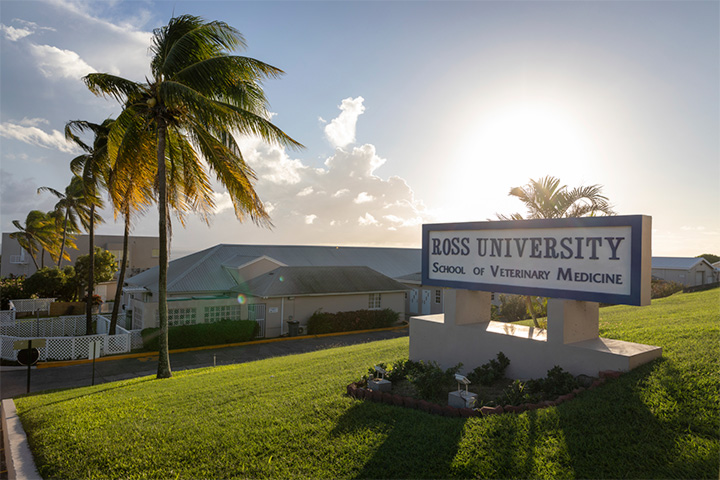
Ross University School of Veterinary Medicine offers an AVMA-accredited, accelerated DVM taught first on its St. Kitts campus, followed by clinical training at an affiliated school. Admission considers academic preparation, veterinary experience, an essay, recommendations and a personal interview. Casper is not required; the GRE is recommended but not required.
- Program
- Doctor of Veterinary Medicine (DVM)
- Credential
- DVM
- Location
- St. Kitts, United States
- Casper
- Not required
- Interview
- One-on-one interviews
- Length
- 3.25 years (10 semesters)
Casper Requirement for Ross University School of Veterinary Medicine Veterinary
Ross University School of Veterinary Medicine Veterinary does not require Casper for the 2026-2027 cycle.
Casper is not required for DVM admission.
Ross University School of Veterinary Medicine Veterinary Application Deadlines 2026-2027
- Apply through
- Ross Vet online application or VMCAS
- Applications open
- Year-round for direct applications
- Application fee
- $100
| What | When |
|---|---|
| Direct application | Rolling; applications for each class are reviewed until it is full |
Apply once through either route. Direct applications are accepted year-round; VMCAS applications may be submitted while its cycle is open.
Ross University School of Veterinary Medicine Veterinary Admissions Statistics
Period: September 2025, January 2026 and May 2026 incoming classes, including new and advancing Vet Prep students
- Average GPA: 3.25 enrolled overall GPA; 3.23 enrolled prerequisite GPA
- Average test score: 300 GRE
Published GPA and GRE averages describe enrolled students, including new and advancing Vet Prep students; they are not admission minimums.
Eligibility Requirements for Ross University School of Veterinary Medicine Veterinary
- Degree / credits
A minimum of 48 college credits, including prerequisites, is required; completing an undergraduate degree is strongly recommended, not required.
- Language proficiency
If English is not your primary language, or your undergraduate degree was not taught in English, provide official English-proficiency scores. Accepted options are TOEFL iBT, IELTS, PTE Academic and Cambridge English: Advanced or Proficiency; Ross Vet also lists IGCSE English First Language Grade B.
Admission pathways
- Advanced standing: Evidence of prior coursework from an AVMA-accredited veterinary program may qualify for advanced standing.
Prerequisites taken within 10 years of application are preferred, not required.
Selection Factors Ross University School of Veterinary Medicine Considers
Prerequisites
| Course | Requirement |
|---|---|
| General biology with lab | 8 semester credits; C- or better Two semesters or three quarters |
| General chemistry with lab | 8 semester credits; C- or better Two semesters or three quarters |
| Organic chemistry with lab | 4 semester credits; C- or better One semester |
| Physics with lab | 4 semester credits; C- or better One semester; algebra, trigonometry or calculus prerequisite |
| Biochemistry | 3 semester credits; C- or better Upper-level course with organic chemistry prerequisite |
| Cell biology | 3 semester credits; C- or better Lab recommended |
| Mathematics | 3 semester credits; C- or better Pre-calculus, calculus or statistics |
| English | 3 semester credits; C- or better Composition or another writing-intensive course |
| Advanced science | 6 semester credits; C- or better Upper-level science courses encouraged |
| Humanities and social sciences | 6 semester credits; C- or better Communication and wellness courses encouraged. Up to two prerequisite courses may be pending at application; at least half of required lab work must be completed in person. Coursework within 10 years is preferred, not required. |
GPA
- How it is calculated
Overall GPA and prerequisite GPA
Published enrolled-student averages are not admission minimums.
Admissions tests
- GRE (optional): Highly recommended, not required. Applications including a GRE score receive priority in review regardless of score; submit scores using Ross Vet institution code 2639.
- TOEFL iBT (required for some applicants): Preferred section scores: Listening 25, Writing 22, Speaking 22, Reading 23
- IELTS (required for some applicants): 7.0
- PTE Academic (required for some applicants): 67
- Cambridge English: Advanced or Proficiency (required for some applicants): Overall 185
- IGCSE English First Language (required for some applicants): Grade B
Experience and volunteer hours
Required.
At least 150 hours of professional veterinary experience or veterinary research are required. Supervision by a practicing veterinarian is preferred, but comparable experience may be considered. Provide proof in recommendation letters or a CV/resume.
Supplementary application
Submit a statement of purpose or VMCAS personal statement, official undergraduate transcripts, and two recommendation letters: one from a science professor and one from a veterinarian familiar with your work. Include a CV or resume if the letters do not document your required experience hours.
How applicants are ranked
Completed applications receive holistic review of academic preparation, experience and personal qualities. Applicants meeting initial requirements are invited to a personal interview. The interviewer sends a summary and application materials to three Admissions Committee members, who decide on DVM admission, Vet Prep or denial.
Interview Format at Ross University School of Veterinary Medicine
Format: One-on-one interviews
A personal interview with an admissions representative informs the Admissions Committee's holistic review.
- Who is invited
- Applicants whose completed materials meet initial requirements
- When
- Often within two to four weeks after initial application materials are received
Practice under timed, realistic conditions with Bright Doctor's AI Interview Simulator.
Prepare for Your Admissions Interview
Access Bright Doctor's AI Interview Simulator with realistic practice conditions and personalized mentorship from current medical students, all on one web-based platform.
Start Practicing FreeCurriculum at Ross University School of Veterinary Medicine Veterinary
- Program length
- 3.25 years (10 semesters)
- Structure
Seven preclinical semesters on the St. Kitts campus, followed by three clinical semesters at an affiliated AVMA-accredited veterinary school.
- Campuses
- St. Kitts campus
The accelerated 10-semester DVM includes at least 45 weeks of supervised clinical experience, including at least 20 weeks of core rotations.
Campus and facilities
Complete the first seven semesters on campus in St. Kitts; complete clinical training at an affiliated veterinary school.
Tuition and Funding at Ross University School of Veterinary Medicine
- Total DVM tuition: $252,400
- Preclinical tuition per semester: $25,640
- Clinical sciences tuition per semester: $25,640
- Seat deposit: $1,000
- One-time education resource fee: $780
- Student government fee per applicable semester: $24
- Student AVMA fee per semester: $19.20
- Optional health insurance per semester: $1,657
- Approximate books and supplies, semesters 1-7: $670 per semester
- Approximate books and supplies, semesters 8-10: $652 per semester
Rates effective from September 2026 and subject to change. Students must have health insurance; they may use private coverage instead of the student plan.
Ross University School of Veterinary Medicine's Mission and Values
Ross University School of Veterinary Medicine confers a Doctor of Veterinary Medicine (DVM) degree, which is accredited by the American Veterinary Medical Association.
What Applicants Are Saying
Applicants report positive experiences with Ross Vet interviews, tracked via the SDN Interview Experience Score. The student body is described as moderately cooperative, supporting peers through the accelerated curriculum. First-semester students highlight outstanding professors and strong educational quality. Mature applicants, including those over 30, value the 3.25-year timeline for quicker entry into practice. Current students praise professors' quality despite program intensity. Engage in forums like SDN for cycle-specific insights from class of 2030 hopefuls.
Shared by applicants and students on forums and communities. It is anecdotal, not official program information.
How to Prepare Your Ross University School of Veterinary Medicine Veterinary Application
- Check all prerequisite courses and the 48-credit minimum; up to two courses may be pending at application.
- Document 150 hours of professional veterinary experience or research in your letters or CV.
- Prepare your statement of purpose, transcripts and two required recommendations.
- Consider the recommended GRE; submit English-proficiency evidence if applicable.
- Prepare for a personal interview if invited; apply directly while places remain.
More About Ross University School of Veterinary Medicine Veterinary
- Accreditation
AVMA-accredited; qualifies graduates for licensure in the US and Canada.
Frequently Asked Questions About Ross University School of Veterinary Medicine Veterinary
Does Ross Vet require Casper for admissions?
No. Casper is not required for DVM admission.
What is the average GPA for Ross Vet DVM enrollees?
The published enrolled averages are 3.25 overall and 3.23 for prerequisites.
How many veterinary hours does Ross Vet require?
At least 150 hours of professional veterinary experience or veterinary research; veterinarian supervision is preferred, but comparable experience may be considered.
What is the Ross Vet DVM program length?
3.25 years across ten semesters: seven on St. Kitts and three in clinical training.
Does Ross University School of Veterinary Medicine require GRE?
No. The GRE is highly recommended, and applications with scores receive priority in review.
What English proficiency tests does Ross Vet accept?
Ross Vet lists TOEFL iBT section scores, IELTS 7.0, PTE Academic 67, Cambridge English overall 185, and IGCSE English First Language Grade B.
What do Ross Vet interviews involve?
Applicants meeting initial requirements may be invited to a personal interview with an admissions representative.
Is Ross Vet DVM AVMA-accredited?
Yes. Graduates who pass the NAVLE are eligible to practice in the U.S., Canada and Puerto Rico.
Sources
- veterinary.rossu.edu: rusvm dvm requirements
- veterinary.rossu.edu: tips for preparing a strong vet school application
- canamgroup.com: admission
- veterinary.rossu.edu: requirements
- veterinary.rossu.edu: dvm admissions
- en.wikipedia.org: Ross University School of Medicine
- metaintro.com: vet school requirements
- veterinary.rossu.edu: how hard is it to get into vet school
- veterinary.rossu.edu: curriculum
- veterinary.rossu.edu: doctor of veterinary medicine degree program
- utppublishing.com: jvme.36.2.226
- veterinary.rossu.edu: dvm program
- veterinary.rossu.edu: ross vet 5 tips for interviewing
- aavmc.org: Veterinary School Interview Tips 2025
- medicmind.co.uk: free vet mmi stations
Last updated: September 26, 2026