
View Other Schools
🇨🇦 Canada

Simon Fraser University Stephens Family School of Medicine

Surrey, BC Class Size: 64
Visit School Website

Gaining admission to Simon Fraser University Stephens Family School of Medicine is Ultra Competitive. Applicants typically have an average GPA of 4.06/4.33 and an average MCAT score of N/A.

Statistics

To summarize, listed below are the most important academic statistics for Simon Fraser University Stephens Family School of Medicine applicants:

Average GPA:
4.06/4.33
Average MCAT:
N/A
Competitiveness:
Ultra Competitive
Note: Competitiveness is assessed based on the school's acceptance rate, average MCAT, and average GPA.
1-On-1 Review

Students Who Got In, Helping You Get In

Get your application reviewed by top medical students on AdmissionPeer™
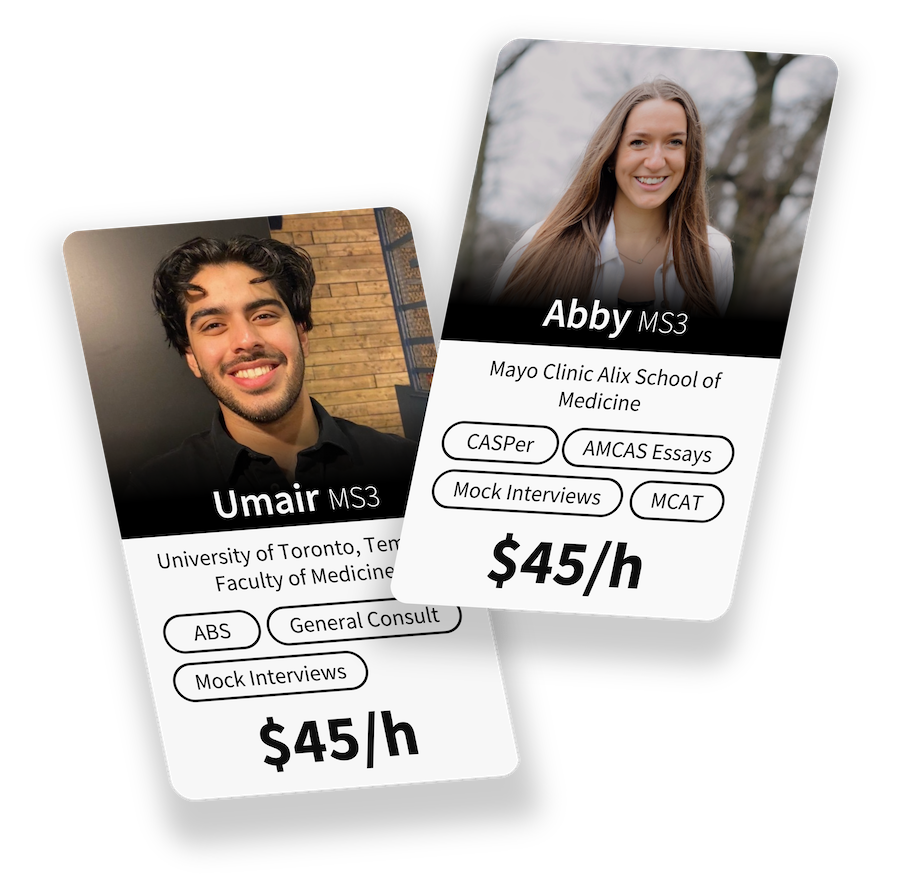
AMCAS/TMDSAS/AACOMAS
Interview Prep
Casper/PREview
Strategy & Update Letters
Access AdmissionPeer

Tuition

Affording medical school can be tough, often requiring students to take on significant loans. Information about the yearly tuition for Simon Fraser University Stephens Family School of Medicine is below.

In-State Tuition:
$31,204.14
Out-of-State Tuition:
$31,204.14

For more information about tuition at Simon Fraser University Stephens Family School of Medicine, visit the following link: https://www.sfu.ca/medicine/admissions/financial-resources.html

Friendliness

Some schools prefer in-state candidates, while others are more receptive to out-of-state or international applicants. View our school "friendliness" scores for Simon Fraser University Stephens Family School of Medicine below:

IN-STATE

In-State Friendliness:
Very Friendly

OUT-OF-STATE

Accepts Out-of-State:
No
Out-of-State Friendliness:
Not Friendly

INTERNATIONAL

Accepts Canadian:
Yes
Accepts International:
No
International Friendliness:
Not Friendly

Canadian citizens and permanent residents only; international applicants are not accepted. The Open Stream is for residents of B.C., Yukon, the Northwest Territories and Nunavut, and the Indigenous Stream is open to First Nations, Inuit and Métis applicants from anywhere in Canada.

Note: Most schools will be labelled "Neutral" for In-State Friendlines because they don't have a strong bias for in-state applicants compared to out-of-state applicants. In other words, we believe these schools view In-State and Out-State applicants more or less equally. Schools labelled as "Out-of-State Friendly / Very Friendly" have a high proportion of their class filled with Out-of-State applicants.

Mission Statement

It is always important to read and understand a medical school's mission statement before applying. Often, you will find out what the medical school stands for, and if you fit in with the general "vibe" of the medical school. However, being honest, most medical schools have the same run-of-the-mill mission statement as everybody else. Anyways, you can be the judge. Below you can find the mission statement for Simon Fraser University Stephens Family School of Medicine:

Simon Fraser University Stephens Family School of Medicine Mission Statement:
To advance community-based primary health care through education, scholarship, innovation, research and service.

For more information on the mission statement for Simon Fraser University Stephens Family School of Medicine, visit the following link: https://www.sfu.ca/medicine/about/mission-and-vision.html

Situational Judgement Tests

Simon Fraser University Stephens Family School of Medicine does not require the completion of either the Casper® nor the AAMC PREview™ examinations.

Casper®:
No
AAMC PREview™:
No

Dates, Deadlines, and Fees

Throughout your application cycle, there are many dates to be cognizant of in order to ensure the successful completion of your application.

Primary Application Deadline:
October 7
Secondary Application Deadline:
Secondary Application Fee:
N/A
Note: The primary application deadline refers to when your primary application (i.e., the initial AMCAS/AACOMAS/TMDSAS application) needs to be completed. Please be aware that there are processing times associated with primary applications—for instance, there can be a several week processing time associated with verifying your acadmic transcripts when initially submitting the AMCAS application. Upon receipt of the primary application, most schools will then shortly send you a secondary application with targeted essay questions relevant to the specific school.

The secondary application deadline is the final day for all your application materials to be together, which includes submitting the secondary essays, all letters of recommendation, all test scores, etc. Sometimes, schools may have earlier deadlines for letters of recommendation. However, note that for the vast majority of schools it is best to submit your secondary application as soon as possible: within 2 weeks of receiving the secondary application is a good rule-of-thumb.

Below are some other helpful dates:

Interview Cycle Start:
March 13
Interview Cycle End:
March 14
Medical School Interview QBank INTERVIEW COMING UP?

Medical School Interview Question Bank

Learn to provide expert answers with expert questions & model answers.

600+ Questions & Answers
50+ Health Policy & Topic Banks
Interview Simulation Platform
Time & Record Yourself
Save Your Video Responses
MMI & Traditional Style
Access 600+ Expert Answers to Interview Questions

Prerequisite Courses

Most schools have a list of prerequisite courses that you need to have completed before matriculating. View information provided for Simon Fraser University Stephens Family School of Medicine below:

Interpreting Semester Hours
Typically,
3 Semester Hours = A single semester-long course = 1 or 2 quarters
4 Semester Hours = A single semester-long course + associated lab unit
6 Semester Hours = Two semester-long courses = 3 quarters
8 Semester Hours = Two semester-long courses + two associated lab units

PHYSICS

Semester Hours:
Lab?
Not Required

CHEMISTRY

GenChem = General Chemistry

OChem = Organic Chemistry

Biochem = Biochemistry

GenChem Semester Hours:
GenChem Lab?
Not Required
OChem Semester Hours:
OChem Lab?
Not Required
Biochem Semester Hours:
Biochem Lab?
Not Required

BIOLOGY

GenBio = General Biology

HL Bio = Higher Level Biology

GenBio Semester Hours:
GenBio Lab?
Not Required
HL Bio Semester Hours:
HL Bio Lab?
Not Required

GPA option only: 6 units of life science (two courses of at least 3 units, one at the 200 level or higher, minimum B-), e.g. biology, anatomy, physiology, biochemistry, genetics, microbiology, immunology or neuroscience. Chemistry and physics do not count.

HUMANITIES & BEHAVIORAL SCIENCES

Semester Hours:

All options: 6 units of humanities or social science (two courses of at least 3 units, any level, minimum B-), such as psychology, sociology, anthropology, economics, philosophy, history or Indigenous studies. Second-language courses do not count.

ENGLISH/WRITING

Semester Hours:

No English course is required. Applicants whose degree was not taught and examined in English must meet an English proficiency minimum (e.g. IELTS Academic 7.0 overall, 6.5 per section).

MATHEMATICS/STATISTICS

Mathematics Semester Hours:
Statistics Semester Hours:

OTHER REQUIRED COURSES

All options: one university-level, for-credit course of at least 3 units focused on Indigenous peoples in a Canadian context (minimum B-), with a final grade by the application deadline.

OTHER RECOMMENDED COURSES

Critical reasoning and general science courses are strongly recommended.

SOURCE: https://www.sfu.ca/medicine/admissions/before-you-apply/academic.html

Special Programs

Many schools have dual-degree programs for motivated applicants. View the ones offered at Simon Fraser University Stephens Family School of Medicine below:

MD+PhD (MSTP - Medical Scientist Training Program):
MD+MPH (Public Health):
MD+MBA (Business, Healthcare Administration):
MD+JD (Law):
MD+MA (Master of Arts):
MD+MS (Master of Science):

Contact Information

View contact information (phone and email) available to contact Simon Fraser University Stephens Family School of Medicine below:

CONTACT #1

Title:
MD Admissions Office
E-mail:
med_mdadmissions@sfu.ca
Phone:

CONTACT #2

Title:
Transcripts and admissions documents
E-mail:
med_transcripts@sfu.ca
Phone:

Secondary Application Essay Prompts

Below are the past secondary (supplemental) application essay prompts for Simon Fraser University Stephens Family School of Medicine.

Two brief statements describing how your experiences or achievements align with the SFU Stephens Family School of Medicine's mission, mandate and priorities.
Indigenous Admissions Stream only: a short written reflection describing your Indigenous lived experience and how it has shaped your path. [1 page]

Interview Questions

Below are common interview questions that you might encounter on your important day for Simon Fraser University Stephens Family School of Medicine.

What factors influenced your decision to pursue medicine, and why does a school focused on community-based primary care fit your goals?
What does strong primary care mean to you, and why is it often described as the foundation of the health-care system?
Tell us about a community you belong to or contribute to and what it has taught you about the kind of physician you want to become.
Many people in B.C. still do not have a family doctor; what do you think is driving this shortage, and how could new physicians help address it?
Surrey and the Fraser region are home to many languages and cultures; how would you make sure a patient who does not share your language receives safe, high-quality care?
What does cultural safety mean to you, and how would you put it into practice when caring for patients?
The In Plain Sight report documented Indigenous-specific racism in B.C. health care; what responsibilities do individual physicians have in responding to it?
How would you build trust with a patient whose community has been harmed by the health-care system in the past?
What does social accountability mean for a medical school, and how would you practise it as a physician?
Describe a time you worked on a team whose members had very different backgrounds or opinions, and how you helped the group move forward.
What would it take for you to be an effective member of a team-based primary care clinic that includes nurses, pharmacists, social workers and other professionals?
Tell us about a time you faced a significant challenge or setback and what you learned from how you responded.
Describe a situation where you had to make an important decision without all the information you wanted, and how you handled the uncertainty.
Tell us about a time your words or actions had an unintended impact on someone else and what you did about it.
Describe a time you changed your mind after hearing a perspective very different from your own.
A patient insists on antibiotics for what you believe is a viral infection and says they will find another doctor if you refuse; how would you handle the conversation?
You notice that a classmate in your small-group sessions regularly takes credit for work that others have done; what would you do?
An older patient wants to keep living alone at home even though their family and care team think it is unsafe; how would you approach the situation?
Should physicians be allowed to decline to provide a legal service, such as medical assistance in dying, because of their personal beliefs?
How do social determinants of health such as housing, income and food security shape the problems a family doctor sees, and what can a physician realistically do about them?
What role should family physicians play in responding to B.C.'s toxic drug crisis?
What are the benefits and risks of using virtual care and artificial intelligence in primary care, especially for underserved communities?
If you were given the resources to improve health in one underserved community in B.C., what would you focus on first and why?
Rural, remote and northern communities, including those in the territories, struggle to attract and keep physicians; what would draw you to practise where the need is greatest?
SFU's MD program runs year-round for three years; how would you look after your own well-being and avoid burnout in such an intensive program?